Short problem sets to go with the one-minute videos on geometry and topology. School mathematics is enough. Every problem has a hint and an answer you can reveal, and every set comes as a printable PDF: the problems on page one, the answers on page two.
Where do repelling electrons settle on a ball? From two electrons to a short proof of the cases N = 2, 3, 4, and why a cube is the wrong answer for eight.
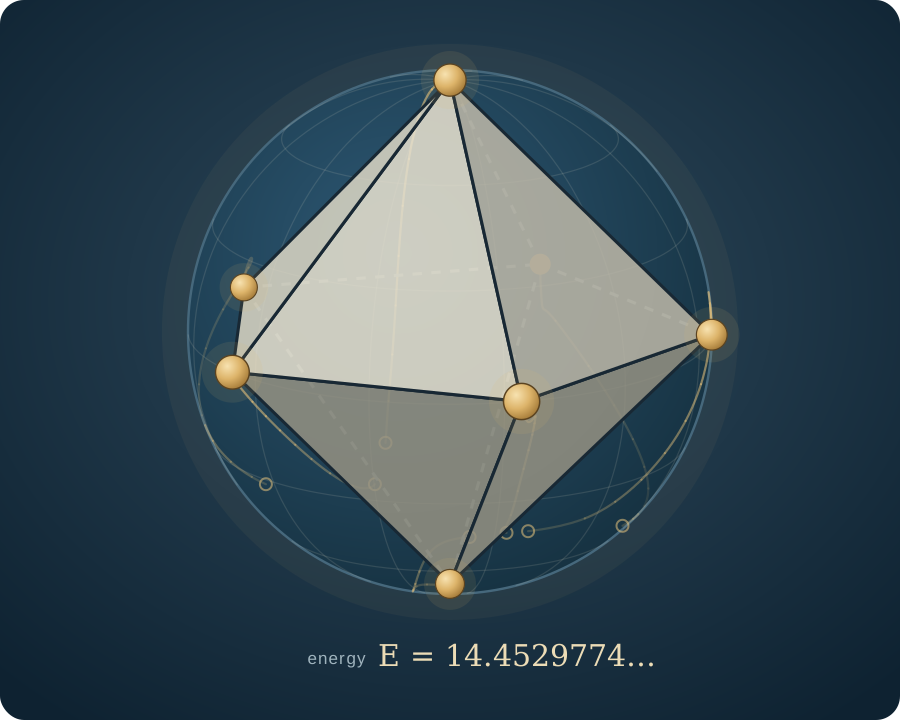
Put N electrons on a sphere of radius 1. Every pair repels, and the energy of an arrangement is the sum of 1/d over all pairs, where d is the distance between the two electrons. The Thomson problem asks for the arrangement with the smallest energy. The story behind it, including the computer-checked proofs of 2026, is in the article The Thomson problem: where do electrons settle on a sphere?
Two electrons sit on the sphere. Their energy is 1/d. Where should they sit to make the energy as small as possible, and what is the smallest energy?
Hint
How far apart can two points of the sphere be?
Answer
At opposite ends of a diameter. Since d ≤ 2, the energy is at least 1/2, with equality exactly when d = 2.
2
Count the pairs
Warm-up
How many pairs are there among N electrons? How many among 400?
Six electrons sit at the vertices of a regular octahedron, (±1, 0, 0), (0, ±1, 0), (0, 0, ±1). Show that their energy is 6√2 + 3/2 ≈ 9.9853.
Five electrons: one at each pole and three forming an equilateral triangle on the equator. Show that their energy is 1/2 + 3√2 + √3 ≈ 6.4747.
Hint
Sort the pairs by distance. In (b) there are two different distances, in (c) three.
Answer
N(N − 1)/2; for 400 electrons that is 79,800 pairs.
12 pairs at distance √2 and 3 pairs of opposite vertices at distance 2: 12/√2 + 3/2 = 6√2 + 3/2.
The poles are 2 apart, each pole is √2 from each equatorial electron (6 pairs), and the triangle has side √3 (3 pairs): 1/2 + 6/√2 + 3/√3, which equals 1/2 + 3√2 + √3.
3
The cube is not the answer
Medium
Eight electrons sit at the vertices of a cube inscribed in the sphere, so the edge of the cube is 2/√3. A calculator helps.
Show that their energy is 6√3 + 3√6 + 2 ≈ 19.7408.
Turn the top face of the cube by 45° about the vertical axis. Find the new distances and show that the energy drops to about 19.6816.
Hint
The squares stay at heights ±1/√3, at distance √(2/3) from the axis. Two points on different squares, whose positions differ by an angle θ around the axis, are at distance d with d² = (4/3)(2 − cos θ).
Answer
There are 12 edges of length 2/√3, 12 face diagonals of length 2√2/√3 and 4 long diagonals of length 2, so E = 12·√3/2 + 12·√3/(2√2) + 4/2, which is 6√3 + 3√6 + 2.
Inside each square nothing changes: 4 sides of length 2/√3 and 2 diagonals of length 2√2/√3. Between the squares the angles are now 45° and 135°, eight times each, giving distances of about 1.3130 and 1.8999. So E ≈ 9.3777 + 8/1.3130 + 8/1.8999 ≈ 19.6816. The twist removes the four short vertical edges. Moving the two squares slightly closer together lowers the energy further, to 19.6753: this is the square antiprism, proved optimal in 2026.
4
A lower bound that settles N = 2, 3, 4
Challenge
Let x1, …, xN be points on the unit sphere, let M = N(N − 1)/2 be the number of pairs and let E be their energy.
Show that the sum of |xi − xj|² over all pairs equals N² − |x1 + … + xN|². In particular, it is at most N².
Using the inequalities between the harmonic, arithmetic and quadratic means of the M distances, show that E ≥ M3/2/N.
Check that two opposite points, an equilateral triangle on a great circle and a regular tetrahedron reach this bound. Why does this prove that they are the best arrangements for N = 2, 3, 4?
Explain why the bound is never reached when N ≥ 5.
Hint
(a) Expand |xi − xj|² = 2 − 2 xi·xj and compare with |x1 + … + xN|². (b) For distances d1, …, dM: Σ 1/dk ≥ M²/Σ dk and Σ dk ≤ √(M Σ dk²). (d) When does equality hold in each step?
Answer
The sum is Σ (2 − 2 xi·xj) = N(N − 1) − (|Σ xi|² − N), which is N² − |Σ xi|².
E ≥ M²/Σ dk ≥ M²/√(M·N²) = M3/2/N.
The bound equals 1/2, √3 and 3√6/2 ≈ 3.6742 for N = 2, 3, 4: exactly the energies of these three arrangements. No arrangement can go below the bound, so these are optimal.
Equality forces all M distances to be equal, and at most four points in space are pairwise equidistant. For five electrons the bound is 6.3246, while the best energy is 6.4747.
5
Euler’s formula and the neighbors
Medium
Join neighboring electrons by edges so that the sphere is divided into triangles, each edge shared by two triangles. Let V, E and F be the numbers of vertices (electrons), edges and triangles (here E is not the energy), and let deg v be the number of neighbors of v.
Show that 3F = 2E and that the degrees add up to 2E.
Use Euler’s formula V − E + F = 2 to show that Σ (6 − deg v) = 12.
Suppose every electron has 5, 6 or 7 neighbors. Show that there are exactly 12 more electrons with five neighbors than with seven.
Show that at least four electrons always have fewer than six neighbors.
Hint
(b) Write 6V − 2E using (a) and Euler’s formula. (d) Every electron has at least three neighbors.
Answer
Every triangle has three edges and every edge lies in two triangles; every edge has two ends.
F = 2E/3, so V − E/3 = 2, that is 6V − 2E = 12; and Σ (6 − deg v) = 6V − 2E.
Electrons with six neighbors contribute 0, those with five +1 and those with seven −1.
The positive terms add up to at least 12 and each is at most 3, so at least four electrons have fewer than six neighbors. The tetrahedron shows that four can happen. This is the same count that forces twelve pentagons on a soccer ball.
Bonus for programmers. Scatter N points on the sphere, move each one a small step along the total repulsive force, push it back onto the sphere, and repeat. Try N = 5, 7 and 8, and compare your energies with the table in the article.
SET 2 · THE ERDŐS UNIT DISTANCE PROBLEM
Points at distance 1
In 1946 Paul Erdős asked: if you place n points in the plane, how many pairs of them can be exactly 1 apart? Write u(n) for the largest possible number. Square grids give about n1 + c/log log n pairs, and Erdős conjectured that one cannot do much better. In May 2026 OpenAI announced that one of its AI models had disproved this conjecture, with arrangements that have at least n1+δ such pairs for a fixed δ > 0; mathematicians have checked the proof. The true size of u(n) is still unknown. The first problem is the question from the video.
What is the largest number of pairs at distance exactly 1 among four points in the plane? Find an arrangement and explain why you cannot do better.
Hint
Could all six pairs be at distance 1? Start with three points at mutual distance 1.
Answer
Five: two equilateral triangles with side 1 sharing a side form a rhombus whose four sides and short diagonal have length 1. Six is impossible: if A, B, C form an equilateral triangle with side 1, the only other point at distance 1 from both A and B is the mirror image D of C in the line AB, and |CD| = √3.
2
Build them up
Warm-up
Find six points with nine pairs at distance 1.
Find seven points with twelve pairs at distance 1.
Show that for every n ≥ 2 there are n points with at least 2n − 3 pairs at distance 1.
Hint
Use equilateral triangles with side 1. For (b), think of a regular hexagon.
Answer
A triangle with side 2 cut out of the triangular grid: its three corners and three midpoints give nine unit segments.
A regular hexagon with side 1 together with its center: six sides and six spokes.
A strip of equilateral triangles: each new point forms an equilateral triangle with the previous two and adds two unit distances, so 1 + 2(n − 2) = 2n − 3.
3
Erdős’s grid trick
Medium
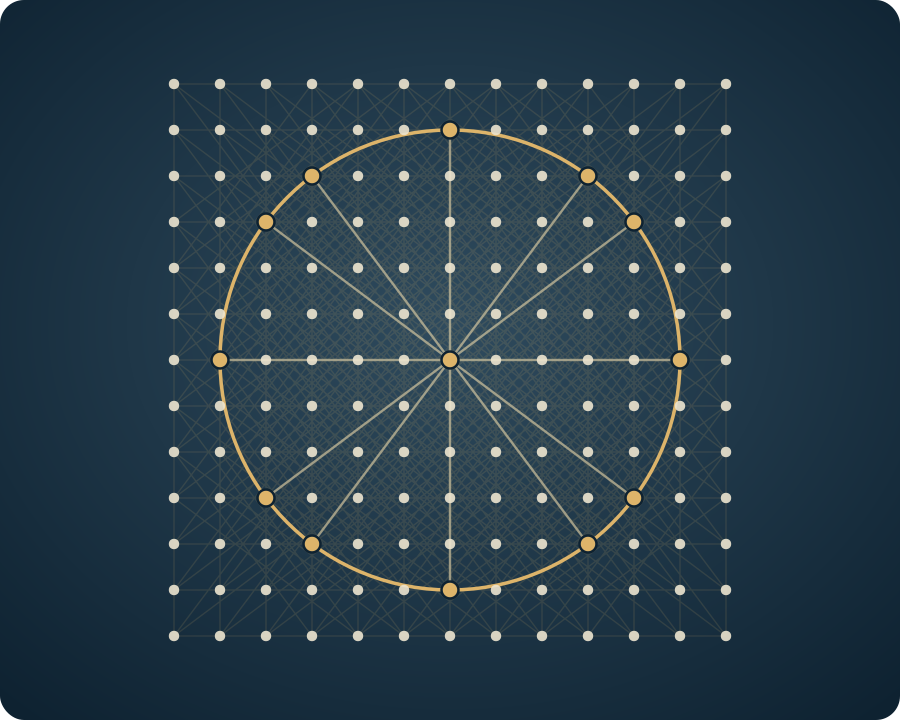
How many points with integer coordinates lie at distance 5 from the origin?
In a 13 × 13 square grid (169 points), count the pairs at distance exactly 1 and the pairs at distance exactly 5. Shrinking the grid by a factor of 5 turns the second number into unit distances.
Find a distance with 16 grid points around the origin.
Hint
(a) 25 = 5² + 0² = 3² + 4². (b) A vector (a, b) fits into a k × k grid in (k − |a|)(k − |b|) positions. (c) Look for a number that is a sum of two squares in two different ways.
Answer
12: (±5, 0), (0, ±5), (±3, ±4), (±4, ±3).
Distance 1: 2·13·12 = 312 pairs. Distance 5 (six vectors up to sign): 2·13·8 + 4·10·9 = 568 pairs.
For example √65, because 65 = 1² + 8² = 4² + 7². Erdős used distances with more and more such representations, which gives about n1 + c/log log n unit distances.
4
The Moser spindle
Medium
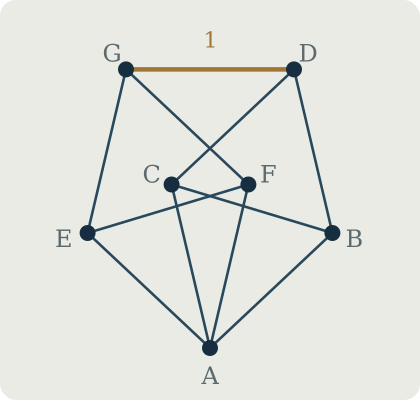
Two rhombi sharing the vertex A, with D and G exactly 1 apart.
Take two copies of the rhombus from Problem 1, made of two equilateral triangles, with a common vertex A. Rotate one copy about A until the far tips D and G are exactly 1 apart.
How far is each tip from A? Find the angle of rotation.
Count the pairs at distance 1 among these seven points.
Show that the seven points cannot be colored with three colors so that every two points at distance 1 get different colors.
Hint
(a) The long diagonal of the rhombus. (c) In one rhombus, the two middle points get two different colors. What does that force for A and D?
Answer
The tips are √3 from A, so the angle θ satisfies 2√3 sin(θ/2) = 1, which gives θ ≈ 33.56°.
5 + 5 + 1 = 11.
B and C have different colors, and A and D are both at distance 1 from B and C, so both get the third color. Likewise A and G share a color, so D and G do too, although |DG| = 1. Found by Leo and William Moser in 1961, this shows that the plane needs at least four colors; in 2018 Aubrey de Grey showed that four are not enough.
5
An upper bound
Challenge
Fix n points in the plane, let u be the number of pairs at distance 1, and let d(p) be the number of points at distance 1 from the point p.
Explain why two different points have at most two common points at distance 1 from both.
Count the triples (p, {q, r}), where q and r are both at distance 1 from p, in two ways, and show that Σ d(p)(d(p) − 1)/2 ≤ n(n − 1).
Use Σ d(p) = 2u and Σ d(p)² ≥ (Σ d(p))²/n to show that u < n3/2.
Hint
(a) Two circles of radius 1. (b) Each pair {q, r} is counted at most twice. (c) You should get 2u²/n − u < n²; solve this quadratic inequality for u.
Answer
The points at distance 1 from q and from r lie on two different circles of radius 1, which meet in at most two points.
For a fixed p there are d(p)(d(p) − 1)/2 pairs {q, r}; for a fixed pair {q, r} there are at most two points p; and there are n(n − 1)/2 pairs.
From (b), (Σ d(p)² − Σ d(p))/2 ≤ n(n − 1) < n², so 4u²/n − 2u < 2n², that is 2u² − nu − n³ < 0. Hence u < (n + √(n² + 8n³))/4 ≤ n3/2. Erdős proved this kind of bound in 1946; the best known today, of order n4/3, is from 1984.
THE BOOK
More questions in the book.
Why Does a Soccer Ball Have 12 Pentagons? starts by counting the patches on a soccer ball and ends with theorems that link the shape of a surface to its curvature. It is written for high-school students and adults; pictures, questions and thought experiments show where the theorems come from.