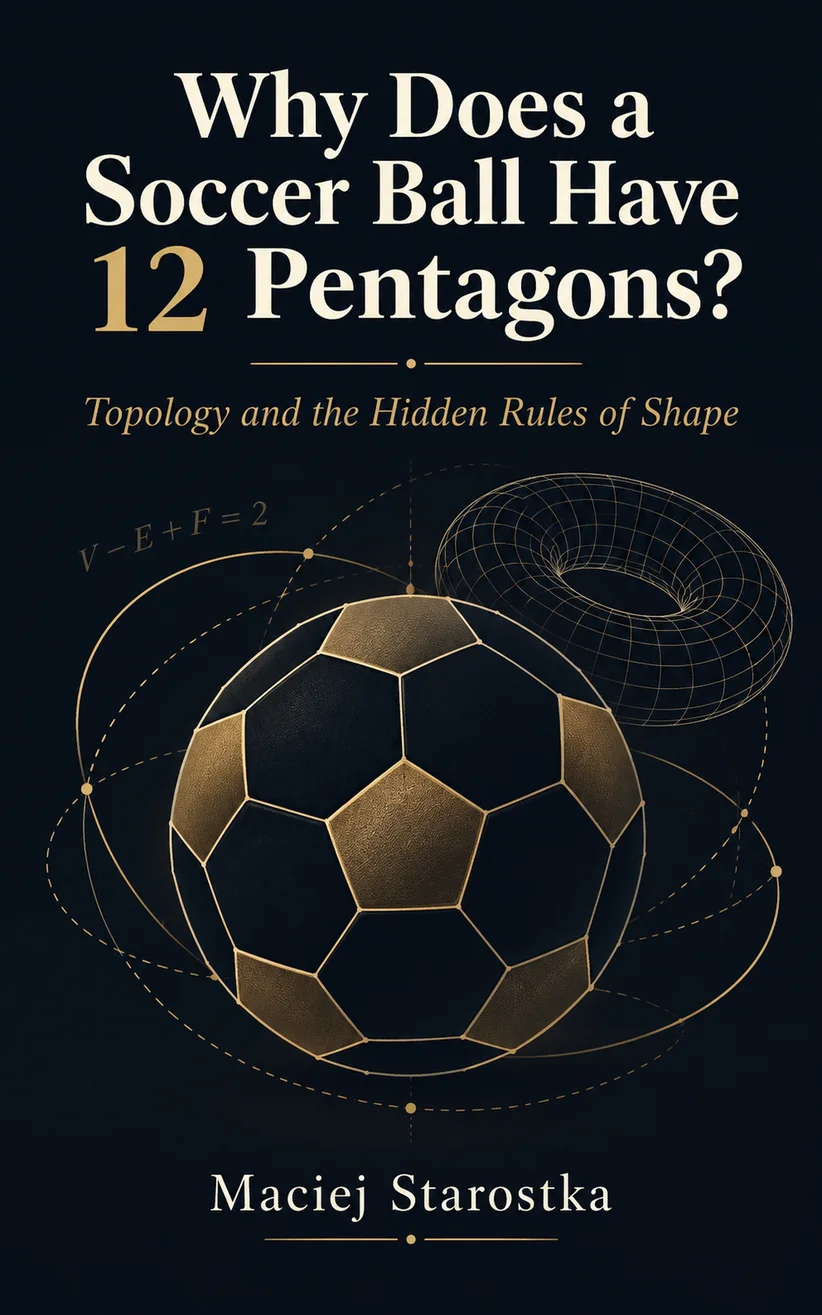
AN ILLUSTRATED EXPLANATION
Why does a soccer ball have exactly 12 pentagons?
The black-and-white ball of the 1970 World Cup had 12 pentagons and 20 hexagons. Twelve is not a design choice. It is forced by a formula that Leonhard Euler described in 1750.

Take a classic black-and-white soccer ball and look closely at its patches. Some have five sides, others six. Count them and you will find twelve pentagons and twenty hexagons. Why twelve? Why not ten, or fourteen?
The answer takes a few lines of algebra. It does not depend on the size of the ball, on the size of the patches, or even on whether they are regular. All that matters is how the patches are joined and that together they cover a sphere.
Three facts about the stitching
Let P be the number of pentagons and H the number of hexagons. We will also count the ball’s vertices (corners), edges (seams) and faces (patches). Their numbers are traditionally denoted V, E and F.

Now count in three different ways:
- Count patches. Every patch is either a pentagon or a hexagon, so F = P + H.
- Count sides. The pentagons contribute 5P sides and the hexagons contribute 6H. But each seam lies between two patches, so it is counted twice: 2E = 5P + 6H.
- Count corners. Three seams meet at every corner. Each seam has two ends, hence 3V = 2E.
Euler’s formula does the rest
For any way of dividing a sphere into polygonal patches, Euler’s formula says
Because 3V = 2E and F = P + H, we can replace V and F:
Multiply by six and use 2E = 5P + 6H:
Every term involving hexagons cancels, so the number of hexagons plays no role at all.
Then why does the familiar ball have 20 hexagons?
The proof does not tell us how many hexagons there are. Twenty comes from the particular solid used as the model for the familiar ball: the truncated icosahedron.
An icosahedron has twelve vertices and twenty triangular faces. Imagine slicing off each of its twelve corners. Five triangles meet at every corner, so each cut leaves a pentagonal face. At the same time, each original triangle, with its three tips cut away, becomes a hexagon. If every cut goes one third of the way along each edge, all the pentagons and hexagons come out regular, with sides of equal length.

That explains both numbers for this particular design. But twenty is not forced by Euler’s formula. A regular dodecahedron is made of twelve pentagons and no hexagons at all, and other networks with three patches at every corner can contain as many hexagons as you like. They will still have twelve pentagons.
Chemists meet the same rule in fullerenes, closed cages of carbon atoms in which every atom is bonded to three others. The C60 molecule has exactly the soccer-ball pattern, and C70 has 25 hexagons. Both have twelve pentagons, as does every other fullerene.
Does every soccer ball have twelve pentagons?
No. Many modern balls use other panel shapes: the ball of the 2014 World Cup was made of six identical propeller-shaped panels. Our conclusion depends on all three conditions: a spherical surface, only pentagonal and hexagonal patches, and three patches meeting at each corner. Change any of them and the counting has to be redone.
The shape of the surface matters as well. On the surface of a doughnut (a torus), Euler’s formula reads V − E + F = 0, not 2. Carry out the same calculation there and you obtain P = 0. A torus can be tiled with hexagons alone, with three meeting at every corner.
Try it yourself
Suppose we also allow heptagons, patches with seven sides, and keep all the other rules. Let S be the number of heptagons and repeat the three counts. You should arrive at
So a spherical ball with one heptagon needs thirteen pentagons. There is a simple way to remember all of this. Give every pentagon +1 point, every hexagon 0 and every heptagon −1. With three patches at every corner, the points always add up to 12 on a sphere and to 0 on a torus.
These points are a discrete version of curvature: pentagons make the surface bulge outwards, heptagons make it saddle-shaped. Their total depends only on the surface, not on the pattern drawn on it. Properties of this kind are what topology studies.
THE BOOK
This is where
the book begins.
This article took Euler’s formula on trust. Chapter 1 of Why Does a Soccer Ball Have 12 Pentagons? proves it. The later chapters follow the same number, V − E + F, to curvature, mountain landscapes, combing a sphere, and the point in a stirred cup of coffee that ends up where it started.