GEOMETRY MEETS TOPOLOGY
The Gauss–Bonnet theorem: how curvature counts holes.
The total Gaussian curvature of a sphere is 4π. For a torus it is zero. The Gauss–Bonnet theorem explains why. It also explains how a creature that never leaves a surface could, in principle, discover its topology.
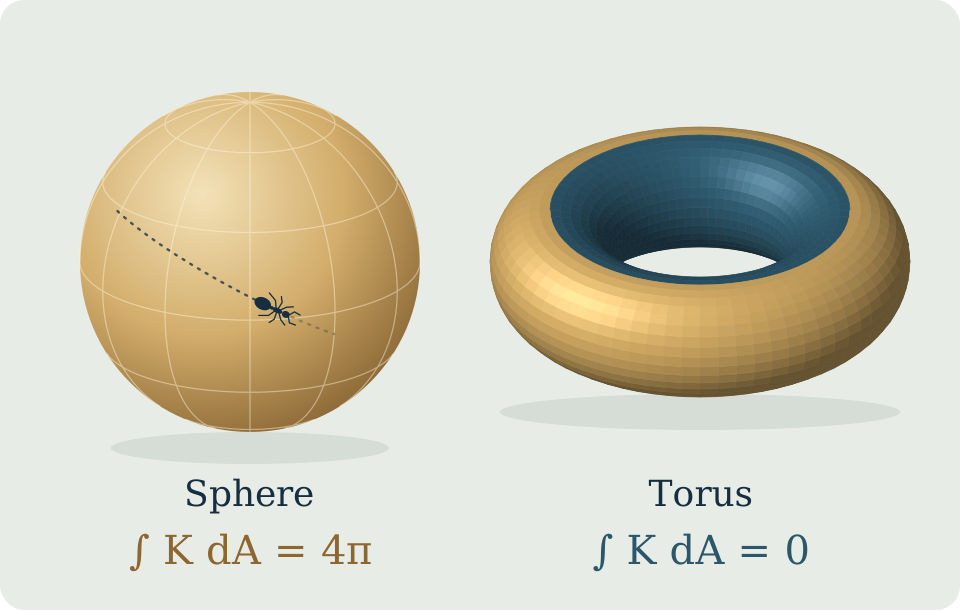
Take a smooth sphere and deform it into a lopsided shape, without tearing it or gluing parts together. Its curvature now varies from place to place. Yet if we add up the right kind of curvature over the whole surface, the total stays exactly the same.
For a sphere the total is 4π. For a torus, the surface of a doughnut, it is 0. For a surface with two handles it is −4π. These numbers depend only on the topology of the surface, not on its size or on the way it sits in space.
What does the Gauss–Bonnet theorem say?
For a smooth, compact surface without boundary, the Gauss–Bonnet theorem states that
Here K is Gaussian curvature, dA is an infinitesimal area element, and χ(M) is the Euler characteristic of the surface. The integral on the left is called its total Gaussian curvature.
Gaussian curvature is positive at a dome-like point, negative at a saddle point and zero on a plane. More precisely, it is the product of the two principal curvatures. Although this definition refers to the way the surface bends in space, Gauss proved that K can be determined from distances measured along the surface itself. He called this result his theorema egregium, the “remarkable theorem”. A cylinder shows what it means: it is curved in space, but it can be unrolled onto a plane without stretching, so its Gaussian curvature is zero.
The right-hand side, by contrast, is a topological number. If we divide a surface into vertices, edges and polygonal faces, then χ(M) = V − E + F. A sphere has Euler characteristic 2; a torus has 0. Gauss–Bonnet says that a geometric measurement and this purely combinatorial count give the same result, up to the factor 2π.
Why is the total Gaussian curvature of a sphere 4π?
Start with a round sphere of radius R. Its Gaussian curvature is the same everywhere, K = 1/R², while its surface area is 4πR². Therefore
The radius cancels. A tiny marble and the Earth have the same total Gaussian curvature in this idealized spherical model. If the sphere is dented or stretched smoothly, its curvature will no longer be constant, but the total is still 4π. That is precisely what the theorem predicts from χ(S²)=2.
Why is the total curvature of a torus zero?
A standard doughnut-shaped torus has different kinds of curvature in different places. On the outside it is dome-like, so K > 0. Around the hole it is saddle-like, so K < 0. Along the top and bottom circles, where the two regions meet, the Gaussian curvature is zero.

The total is zero not because the torus is flat, which it clearly is not, but because the positive and negative contributions cancel. For a torus of revolution this can be checked directly. If θ is the angle around the tube and φ the angle around the hole, then K dA = cos θ dθ dφ, whatever the two radii. The outer half, where cos θ > 0, contributes exactly 4π, as much as a whole sphere, and the inner half exactly −4π. The Euler characteristic of the torus is 0, and Gauss–Bonnet gives
More generally, a connected closed orientable surface with g handles has χ = 2 − 2g, so its total Gaussian curvature is 4π(1 − g). Thus the total distinguishes a sphere from a torus and from surfaces with two or more handles.
Can you measure curvature using triangle angles?
There is a way to recognize curvature without looking at a surface from outside. Draw a triangle whose sides are geodesics: locally shortest paths, the surface’s counterparts of straight lines. Measure its three interior angles α, β and γ.
In the plane their sum is π, or 180°. On a curved surface it need not be. In fact, for a geodesic triangle bounding a disk-like region D,
For example, on a round globe, walk from the North Pole down a meridian to the equator, go a quarter of the way around the equator, and return to the pole along the meridian 90° further east. Each corner of this route is a right angle.

The spherical triangle has angle sum 270°, so its excess is 90°, or π/2 radians. It covers one eighth of the sphere; one eighth of 4π is also π/2. The numbers agree exactly. Where the curvature is negative, as on a saddle, a geodesic triangle has an angle sum smaller than 180°.
What if we asked ants to measure the Earth?
Imagine inhabitants who never leave their surface and have no idea what it looks like from the outside. Could they still work out whether their world is a sphere or something with a handle? In principle, yes: they could measure distances and angles, build a triangulation, and combine local geometric information.
How much territory would each observer need? A 2022 study in PNAS estimated, conservatively, that there are about 20 quadrillion ants on Earth (2 × 10¹⁶). Earth’s total surface area is roughly 510 million square kilometers, or 5.1 × 10¹⁴ m². Divide the area equally among all the ants:

An ant could easily cross a patch of that size. The catch is precision. On a round Earth, a geodesic triangle of area 255 cm² has an angle excess of only about 6 × 10⁻¹⁶ radians. No real ant, and no real instrument, measures angles that accurately. The theorem itself is safe: add up 2 × 10¹⁶ such excesses and you get 12.6 radians, which is 4π.
Surveyors meet the same problem on a larger scale. In 1823, while mapping the Kingdom of Hanover, Gauss measured the triangle formed by three mountain tops, Brocken, Hohehagen and Inselsberg, with sides of 69, 85 and 107 km. Even for a triangle that size, the curvature of the Earth adds only about 15 seconds of arc, roughly 1/240 of a degree, to the angle sum.
The ants have an easier option. They do not need angles at all. It is enough to divide the planet into triangular plots and count the corners, the borders and the plots. Then V − E + F comes out as 2 on a sphere and 0 on a torus, with no measurement error. Gauss–Bonnet guarantees that measuring angles and counting give the same answer.
Why do the local measurements add up to 2πχ?
We can now see where the global Gauss–Bonnet formula comes from. Divide a closed surface into sufficiently small geodesic triangles, and suppose there are V vertices, E edges and F triangles.
For each triangle, the curvature inside it equals the sum of its three angles minus π. Add these equalities over all the triangles. The angles meeting at any vertex fill a full turn, 2π, so all the angles together add up to 2πV. Subtracting π once per triangle gives
Every triangle has three sides and every edge belongs to two triangles. Consequently 3F = 2E. Substituting that count gives

A sum of local angle measurements has turned into a count of vertices, edges and faces. The same Euler characteristic decides a more elementary question: why a classic soccer ball must have twelve pentagons.
Common questions
Does total curvature change when a surface is deformed?
Not for a closed surface, as long as “total curvature” means the integral of Gaussian curvature. The local values change, but the integral stays 2πχ.
Does zero total curvature mean a surface is flat?
No. An ordinary torus has positive curvature on one side and negative curvature on the other. The integral is zero because the contributions cancel.
Does Gauss–Bonnet work for a surface with a boundary?
Yes, but the formula includes additional terms for the geodesic curvature of the boundary and, if the boundary has corners, their turning angles. The compact formula above is for surfaces without boundary.
Does knowing the Euler characteristic determine the surface?
For a connected, closed, orientable surface, it determines the number of handles. It does not tell us the precise shape or size of the surface.
Further reading: Schultheiss et al., PNAS (2022), on the global ant population; Wolfram MathWorld, on the Gauss–Bonnet formula; and Erhard Scholz (2004, in German), on Gauss’s measurement of the Brocken–Hohehagen–Inselsberg triangle.
THE BOOK
The ants come from
Chapter 2.
In Why Does a Soccer Ball Have 12 Pentagons? the ants appear in Chapter 2, “How Could Ants Discover Earth’s Topology?”. It starts from the angle defect of a polyhedron, which needs no calculus, and builds up to Gauss–Bonnet. Chapter 1 proves Euler’s formula.